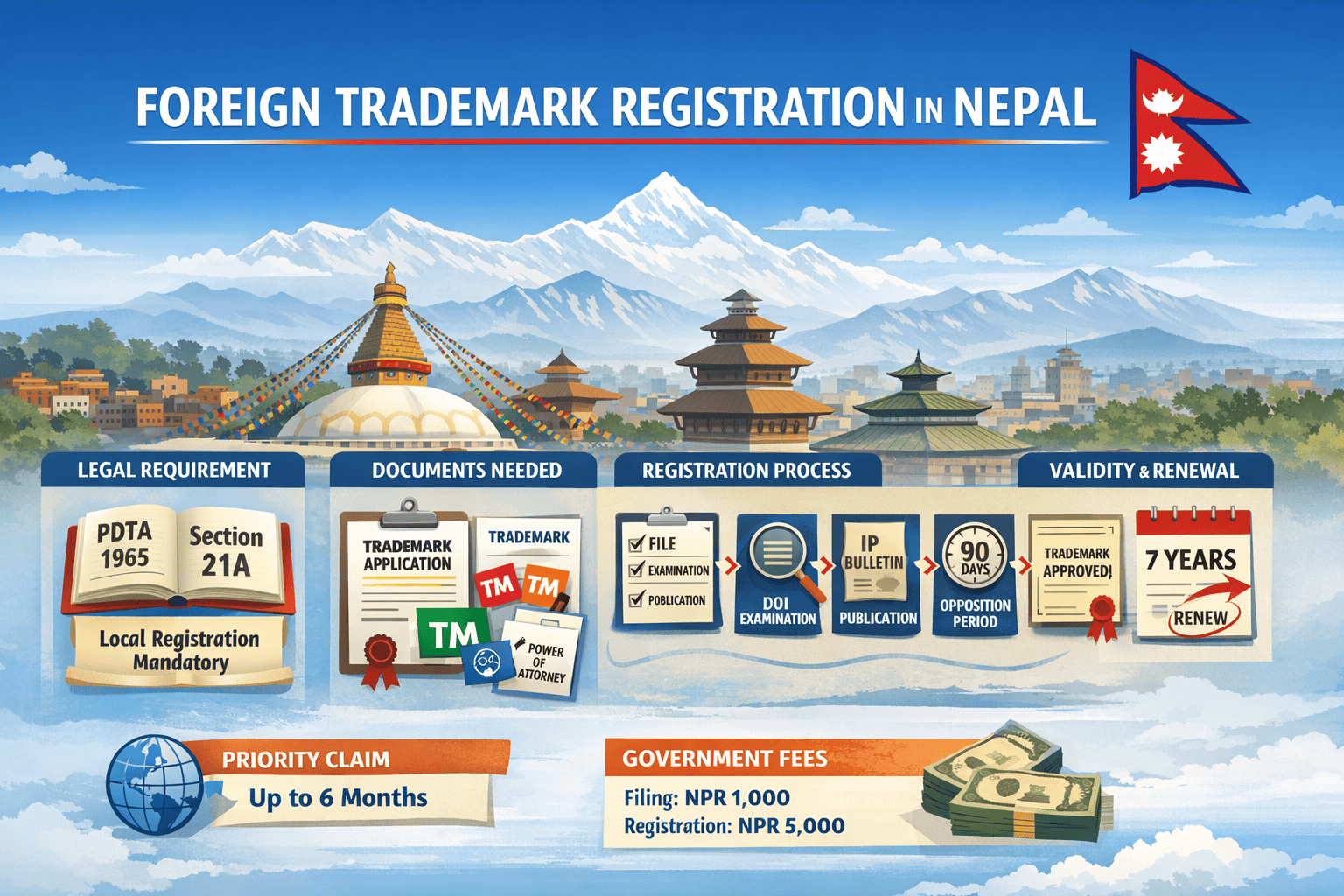
Protecting a trademark is essential for any business expanding into new markets. For foreign companies entering
Nepal, one of the first legal steps is securing trademark protection through local registration. Nepal follows a
strict registration-based system, meaning foreign trademarks receive legal protection only after they are registered
in Nepal, regardless of their global fame or long-standing reputation.
This detailed guide outlines the legal framework, application requirements, process timeline, fees, documentation, and practical considerations for foreign trademark owners. It is designed to help businesses, brand managers, in-house counsel, and IP professionals navigate Nepal’s trademark regime effectively.
1. Legal Basis for Foreign Trademark Protection in Nepal
Nepal’s trademark practice is governed by the Patent, Design and Trademark Act, 1965 (PDTA). The key feature of the law is:
- Section 21A requires every foreign trademark to be individually registered in Nepal to enjoy legal protection and enforceability.
Although Nepal is a signatory to the Paris Convention, the PDTA does not independently recognize “well-known trademarks.” This means:
- Global reputation alone does not grant protection.
- Even well-established international brands must file for registration with the Department of Industry (DOI). In practical terms, local registration is mandatory for protection, enforcement, and licensing.
2. Government Authority Responsible for Registration
All trademark matters in Nepal—registration, examination, publication, opposition, renewal—are managed by:
Department of Industry (DOI)
- Ministry of Industry, Commerce and Supplies Government of Nepal
- Foreign applicants must appoint a licensed local representative to complete filings on their behalf.
3. Requirement of Home-Country Registration
Foreign applicants must submit:
- a Home Registration Certificate (HRC), or
- proof of a pending application filed in their country of origin.
If based on a pending foreign application, the applicant may claim Paris Convention priority for up to 6 months, allowing Nepal’s filing date to relate back to the foreign filing date.
4. Procedure for Registering a Foreign Trademark in Nepal
The process generally involves the following stages:
Step 1: Filing of Application
A foreign applicant—or its authorized Nepali representative—files the application
along with necessary documents.
Step 2: Examination by DOI
The DOI examines the application for:
- Similarity with earlier marks,
- Compliance with legal requirements,
- Misleading or inappropriate elements,
- Conflicts with public morality or national interest,
- Potential damage to the goodwill of existing rights-holders.
Step 3: Publication in the Industrial Property Bulletin
If the DOI finds no objections, the mark is published for public notice.
Step 4: Opposition Period (90 Days)
Any individual or company can file an opposition within 90 days of publication.
Step 5: Final Registration
If no opposition is filed—or once opposition proceedings conclude—the DOI issues the
certificate of registration.
5. Required Documents for Foreign Trademark Registration
| S.N. | Document Required | Copies Needed | Notarization |
|---|---|---|---|
| 1. | Trademark Application | 1 Original | Not Required |
| 2. | Home-Country Registration Certificate / Application Proof | 1 Copy | Notarized |
| 3. | Trademark Label / Logo (Color) | 4 Copies | Not Required |
| 4. | Power of Attorney to Nepali Agent | 1 Original | Not Required |
Foreign applicants must file through an authorized local representative in Nepal.
6. Grounds for Refusal by DOI
The DOI may reject an application if:
- The mark is identical or deceptively similar to an existing registered mark;
- Registration would harm the reputation or goodwill of another;
- The mark violates public morality, cultural norms, or national interest;
- The mark may mislead or negatively impact the public.
7. Timeline for Trademark Registration in Nepal
If the application faces no opposition, the completion time is typically a year.
- Opposition proceedings extend the timeline depending on the complexity of the dispute.
8. Validity and Renewal of Trademark Registration
A registered trademark is valid for:
- 7 years from the registration date.
- Renewable indefinitely for 7-year terms upon payment of renewal fees.
Nepal does not impose a limit on how many times a trademark may be renewed.
9. Classification of Goods and Services in Nepal
Nepal follows the Nice Classification, which divides trademarks into:
- 35 classes of goods
- 11 classes of services
Each class requires a separate application and separate government fees.
10. Government Fees for Foreign Trademark Registration
Application filing fee - NPR 1,000
Registration fee - NPR 5,000
Fees may be revised by the Government of Nepal periodically.
Comparison Chat: Domestic vs. Foreign Trademark Registration in Nepal
| Feature | Domestic Trademark | Foreign Trademark |
| Legal Requirement | Local use or intention to use | Mandatory local registration regardless of foreign use |
| Key document | Proof of applicant identity | Home-country registration certificate |
| Priority claim | Not applicable | Up to 6 months under Paris Convention |
| Representative Requirement | Optional | Mandatory local representative |
| Fees per Class | Same for all | Same for all |
| Recognition of Well-Known Marks | Not automatically recognized | Not recognized without registration |
| Processing Timeline | 1 year | 1 year |
Frequently Asked Questions (FAQ)
1. Do Foreign Trademarks get automatic protection in Nepal?
No. Protection is granted only after local registration with the Department of Industry.
2. Does Nepal recognize well-known trademarks without registration?
No. Even famous trademarks must be registered to be protected.
3. Can foreign applicants claim priority in Nepal?
Yes, up to 6 months, if they filed earlier in another Paris Convention country.
4. How long is a trademark valid in Nepal?
Seven years from registration, renewable indefinitely.
5. Can one application cover multiple classes?
No. Each class requires a separate filing and separate fees.
6. What happens if someone opposes my trademark?
An opposition proceeding begins, and the DOI will decide the dispute before granting registration.
7. Must a foreign company appoint a local representative?
Yes. A local agent is required for filing, responding to examination notices, and completing formalities.
For foreign trademark owners seeking dependable legal representation in Nepal, AHN Legal offers unmatched expertise in trademark registration, protection, and enforcement. With a proven track record in handling foreign trademark matters before Nepali authorities, we are well-positioned to provide precise, commercially sound, and timely assistance. We welcome inquires from international brand owners, agents, and legal practitioners who require trusted local counsel of the highest standard.
Please note that the above mentioned is general information to help the reader understand the related laws in Nepal, and the same should not be construed as a legal opinion. For a detailed opinion or inquiry, please contact:
Mr. Atit Babu Rijal and/or, Mr. Manish Raj Kharel
Partners
atit@ahnlegal.com, manish@ahnlegal.com
977-9851243536, 977-9851183977